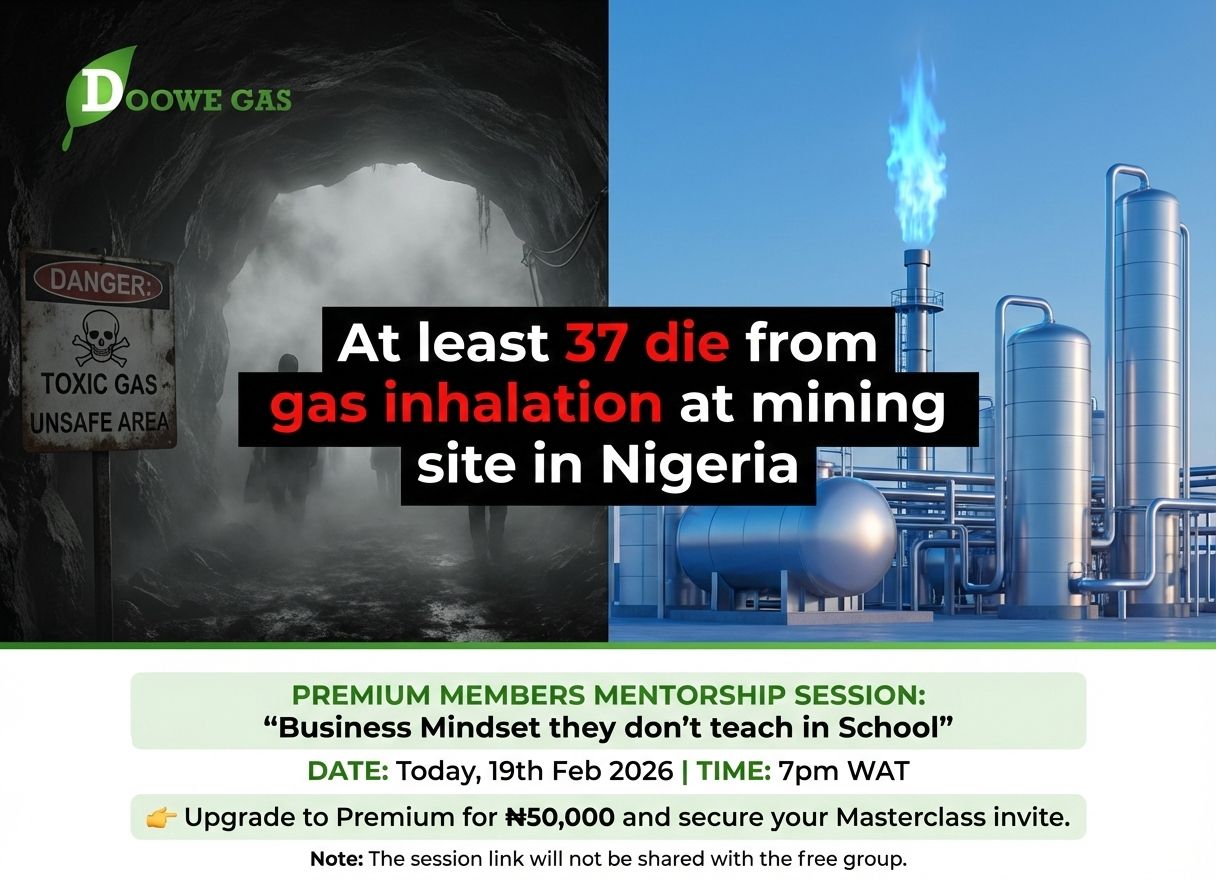

At least 33 miners have died in a suspected carbon-monoxide leak at a lead and zinc mine in central Nigeria’s Plateau state, witnesses have told the BBC.
The tragedy is believed to have happened just before sunrise at a site outside the town of Wase run by the mining company Solid Unity Nigeria Ltd.
Toxic gas is believed to have built up underground in poorly ventilated tunnels, causing the workers to collapse just before the end of their night shift.
They were discovered by those reporting to work in the morning – more than 20 other miners were rescued and rushed to hospital for treatment.
Security personnel have sealed off the mine, which is about 200km (124 miles) south-east of the state capital of Jos, as investigations get under way to find out the cause of the leak.
State officials are yet to visit the area and response efforts have reportedly been slow because of security concerns – armed criminal gangs, known locally as bandits, have been active there in recent years.
The Nigerian government has suspended mining licences in the affected area and ordered an investigation, vowing to release further details in due course.
Safiyanu Haruna, one of the miners who found the bodies at the start of his shift, told the BBC that some of the miners who were underground survived and were taken to a hospital in Wase for treatment.
According to Haruna, the incident occurred at around 06:30 local time (05:30 GMT) killing 37 miners.
He said the miners had just finished performing their early morning Muslim prayers and had returned underground to finish their shift.
The Plateau state government has issued a statement saying that according to its preliminary investigation 33 miners were killed in a blast at the mine – but workers at the scene say this is not the case.
“It was carbon-monoxide gas that leaked and killed them,” Haruna said.
“There was no rescue for them at the time because those who were coming for the morning shift had yet to arrive,” he said.
“It is sad to lose 37 miners who were struggling to make ends meet. We’re disturbed by the incident.”
The victims, believed to be men aged between 20 and 40, were buried shortly afterwards in accordance with local tradition, another local resident told the BBC.
The news has devastated the mainly Muslim community.
Mining disasters occur relatively frequently in Nigeria.
Less than two years ago, dozens of gold miners died after being trapped underground when a pit collapsed in neighbouring Niger state.
Officials believe that incident was caused by torrential rains which had softened the soil.
The tragedy is likely to renew concerns over safety standards in Nigeria’s mining sector.
Nigeria’s Minister of Solid Minerals Development, Dele Alake, said the area was an abandoned lead site with stored minerals prone to releasing toxic gases. Villagers, unaware of the toxic nature of the emissions, reportedly entered the tunnel to extract minerals and inhaled the gas, he said.
Alake ordered the closure of mining areas covered by licence 11810, operated by Solid Unit Nigeria Limited and owned by Abdullahi Dan‑China in Zuraq, following the deaths of villagers allegedly mining in a pit containing dangerous gas emissions.
Preliminary findings showed the victims, aged 20 to 35, died after inhaling the gas while working underground, the security report said.
The Plateau state government said many were feared dead without providing a figure, adding that others were receiving treatment in nearby hospitals.
Security forces have cordoned off the site to prevent further access.
Most mines in Nigeria operate illegally, with limited safety measures and miners often lacking protective equipment.
The federal government has ordered the immediate shutdown of all mining activities in the affected area pending further investigation.
The ministry of roads and transport held a conciliatory meeting between the union, the state department of labor, the Kenya Civil Aviation Authority.
Heirs Energies ascent: Redefining Nigeria’s power and purpose
A seismic shift is vibrating through the sprawling onshore fields of the Niger Delta. In January 2021, a $1.2bn landmark deal sent a clear signal to the global markets: Heirs Energies had arrived. By acquiring a 45 per cent stake in OML 17 from Shell, Total, and ENI, the company did more than purchase an asset; it planted the flag of Africapitalism in the heart of Nigeria’s energy landscape. The message was unyielding—Africans must not only have a seat at the table but must own the future of their natural resources.
At the centre of this revolution is Tony Elumelu, CFR—a consummate investor-banker, philanthropist, and a fierce believer in African capacity. Elumelu has consistently championed the creed that for foreign investors to take Africa seriously, Africans must first demonstrate world-class operational excellence in high-stakes ventures. Heirs Energies was founded to shatter the fallacy that Africa cannot manage its own wealth. Today, that myth is being systematically dismantled and consigned to the dustbin of history.
The path Elumelu chose initially appeared high-risk. To the uninitiated, acquiring “brownfield” assets—mature fields often viewed by oil majors as declining—seemed a precarious move for a new indigenous player. But it proved to be a masterstroke of strategic brilliance. Within just 100 days of taking operational control in July 2021, the “miracle” began. Under the leadership of a seasoned indigenous CEO, Osa Igiehon, production surged from 27,000 barrels per day (bpd) to over 50,000 bpd.
Heirs Energies achieved this growth by focusing on disciplined brownfield optimisation, rehabilitating and restoring existing wells and facilities, as well as maintaining an unwavering commitment to safety and operational excellence.
This feat is even more remarkable considering the operating environment. Battling the twin shadows of the COVID-19 pandemic and systemic oil theft, Heirs Energies achieved the impossible.
Through strategic intervention, Heirs Energies stabilised its operations and significantly reduced theft-related losses from a staggering peak of 97 per cent to less than 10 per cent.
While reviving crude output, Heirs Energies simultaneously ignited Nigeria’s gas ambitions. In November 2021, only six months post-takeover, the company delivered first gas from the Agbada Non-Associated Gas Plant—a project that had languished for over a decade under previous operators. This success provided the critical pulse for the national “Decade of Gas” initiative, immediately necessitating the commencement of Agbada Train-2 to meet domestic demand.
Nigeria Bets On Gas To Drive Africa’s Industrial Growth And Energy Access
By its third anniversary, the results were undeniable. Heirs Energies had moved to a gold standard. Today, the company produces over 50,000 bpd and approximately 120 million standard cubic feet of gas per day (MMscf/d), supplying up to 100 MMscf/d of gas into the domestic market and enabling more than 300 megawatts of power generation.
The momentum reached a fever pitch in December 2025. Heirs Energies signed landmark Gas Flare Commercialisation Agreements with five flare gas offtakers, marking a decisive victory for environmental responsibility.
By partnering with these gas offtakers, the company is accelerating flare reduction and gas monetisation, effectively turning waste into economic value, directly supporting Nigeria’s green energy transition.
Simultaneously, Elumelu leveraged his profound financial influence to secure a $750m financing package —one of the largest funding arrangements ever secured by a locally owned African producer, the same way he facilitated a strategic $500m acquisition of a 20 per cent stake in Seplat Energy. This move represents a powerful horizontal and vertical integration, reminiscent of the historic merger that created today’s UBA. Elumelu does not merely acquire; he creates synergy, infusing every venture with world-class governance and a “winning” culture that turns challenges into blueprints for success.
The Heirs Energies story is a narrative of renewed hope for the continent. The industry is winning, the Niger Delta is winning, and the environment is winning. Through the “Decade of Gas” policy, Nigeria is witnessing an energy revolution that creates thousands of jobs, reduces carbon footprints, and maximises ROI through the revitalisation of existing fields rather than the risky over-drilling of new ones.
These results are a magnet for global capital.
Where Tony Elumelu leads, confidence follows. Nigeria is no longer just a participant in the energy sector; it is a leader. The Giant of Africa has not just awakened—it is fueling the future.
https://www.bbc.com/news/articles/cwyk6nr80kxo
https://punchng.com/heirs-energies-ascent-redefining-nigerias-power-and-purpose/